


Parents get handed two pieces of advice about children and sunlight, and nobody ever explains how they fit together.
The first is to protect children’s eyes from the sun, because ultraviolet damage accumulates over a lifetime and cannot be undone. New Study Examines UV Exposure The second is to get children outside for about two hours a day, because daylight is the best-evidenced way to delay nearsightedness. One says the sun is a hazard. The other says it is a treatment. Taken at face value, they cancel out, and most people quietly resolve the conflict by ignoring whichever one is less convenient that morning.
A study published in Frontiers in Medicine in February 2026 puts the tension in unusually sharp relief. Researchers in Madrid examined 2,262 schoolchildren and measured a visible marker of accumulated ultraviolet exposure on the surface of the eye. Then they checked which children were short-sighted. The children with more evidence of ultraviolet exposure were less likely to be myopic, not more.
That result sounds like it undermines everything parents have been told about UV exposure. It does not, and understanding why is genuinely useful rather than merely academic. What follows is what the study did, what it found, what it cannot tell you, and how to act on two instructions that turn out not to be in conflict at all.
What the Researchers Actually Did
The clever part of this study is the measurement, so it is worth understanding before the findings.
Asking parents how much time their child spends outdoors produces unreliable data. People overestimate, forget, and answer the way they think they should. Researchers studying outdoor time have been stuck with that problem for years.
This team used something physical instead. Conjunctival ultraviolet autofluorescence, usually shortened to CUVAF, is a change in the surface tissue of the eye caused by accumulated ultraviolet exposure. It is invisible under normal light, but photograph the eye under ultraviolet illumination and it shows up as bright patches on either side of the cornea. It is, in effect, a record of how much sun the eye has had, written on the eye itself.
The study, published in Frontiers in Medicine, ran as follows. Children aged 7 to 8 and 11 to 12 were recruited from 39 schools across Madrid, 2,262 in total. Each had a refraction test, with dilating drops used for those found to be mildly or more short-sighted, since without drops a child’s focusing power can mask the true prescription. Families filled in questionnaires covering outdoor activity and close-up work.
CUVAF was photographed and graded in 1,129 of the children, on a three-level scale, by two specialists working independently, with a third settling any disagreement. The researchers then compared children who spent fewer than seven hours a week outdoors against those who spent at least seven.
That design is observational rather than experimental. Nobody was assigned to go outside more. The researchers measured what was already happening and looked for patterns, which matters a great deal when interpreting what came out.
What They Found
The numbers are worth seeing laid out, because the pattern is consistent across several different ways of cutting the data.
| Comparison | Result |
|---|---|
| Myopia in children outdoors 7+ hours a week | 9 percent |
| Myopia in children outdoors less than 7 hours | 18 percent |
| CUVAF present in the higher outdoor group | 31 percent |
| CUVAF present in the lower outdoor group | 18 percent |
| CUVAF present in non-myopic children | 20 percent |
| CUVAF present in myopic children | 10 percent |
| Correlation between CUVAF and myopia across schools | r = −0.6 |
Two findings stand out.
Outdoor time tracked with substantially less myopia. Children getting seven or more hours a week outdoors had roughly half the rate of short-sightedness of those getting less. Each additional hour outdoors was associated with about 2 percent lower odds of myopia, and crossing the seven-hour threshold with roughly half the odds.
The ultraviolet marker tracked the same way. Children with visible CUVAF were less likely to be myopic, and across the 39 schools the relationship between CUVAF prevalence and myopia prevalence was moderately negative.
So the marker of sun exposure behaved as a marker of protection. The authors’ interpretation is that CUVAF is not functioning here as a measure of damage but as an objective fingerprint of time spent outdoors, which is the thing actually doing the protecting. It is a proxy, and a more honest one than a parent’s recollection.
That reframe is the useful contribution. Research on childhood myopia has long been hampered by not being able to verify how much daylight children actually get. A measurement written on the eye, which cannot be misremembered or politely exaggerated, is a genuine step forward for studying UV exposure and outdoor time together.
What the Study Cannot Tell You
The authors are candid about the limits, and reporting them is not a hedge. It is the difference between a finding you can use and a headline you cannot.
It cannot establish cause and effect. The design is cross-sectional, meaning everything was measured at one point in time. It shows that outdoor time and myopia go together inversely. It cannot prove the direction. It is entirely plausible that children who are already short-sighted choose to spend less time outdoors, perhaps because they prefer activities that suit their vision, rather than that staying indoors made them short-sighted. The data cannot separate those two explanations.
Outdoor time was self-reported. CUVAF is objective, but the questionnaire data about hours outdoors is the usual flawed material. The seven-hour threshold rests on what families reported.
Some confounders were not fully controlled. Parental myopia, which is one of the strongest predictors of childhood myopia, and socioeconomic factors that affect both outdoor access and eye care, are hard to disentangle in a study of this shape.
CUVAF is a poor diagnostic test, and the authors say so plainly. It had a high negative predictive value of 91.9 percent, meaning the absence of CUVAF was reasonably informative, but a positive predictive value of only 10.79 percent, sensitivity of 76.5 percent and specificity of 29.6 percent. In plain terms, finding CUVAF on a child’s eye tells you very little about whether they are myopic. It is a research tool for measuring exposure across groups, not a screening test for your individual child.
Younger children accumulate less of it, which weakens the measurement precisely in the age group where early intervention matters most.
None of this makes the study unimportant. It makes it one piece of evidence that fits alongside the randomised trials of outdoor time, which are the stronger basis for the two-hour advice. Treat this study as a methodological advance and a consistent signal, not as proof that sunlight prevents myopia.
Why This Is Not Actually a Contradiction

Here is the resolution, and it is simpler than the study makes it sound.
Daylight and ultraviolet are not the same thing. They arrive together, which is why people conflate them, but they do different things to the eye through different mechanisms.
Brightness appears to be what protects against myopia. Outdoor light is many times more intense than indoor lighting, even under heavy cloud, and that intensity is the leading candidate for how outdoor time slows the eye from growing too long. The effect is thought to run through light levels reaching the retina, not through ultraviolet.
Ultraviolet is what damages the front of the eye. It contributes to cataract, to pterygium, to corneal sunburn and to skin cancers on the eyelids. These are cumulative, largely irreversible, and have nothing to do with myopia.
So the two mechanisms act on different parts of the eye, over different timescales, through different parts of the light spectrum. That is why they are separable in practice.
And separable is the key word, because it means the apparent dilemma dissolves. A child wearing properly rated sunglasses outdoors still receives the bright-light exposure associated with lower myopia risk, because sunglasses reduce overall brightness somewhat while blocking ultraviolet almost entirely. The protective daylight signal gets through. The damaging wavelengths do not.
In the Madrid study, CUVAF was a marker of being outdoors rather than a measure of harm received. A child who spends two hours a day outside wearing good sunglasses and a hat would likely show less CUVAF while still getting the benefit, which is the outcome you actually want and also, incidentally, a limitation of using CUVAF as a proxy in populations where sun protection is common.
The instruction that follows is not a compromise between two risks. It is both things at once: get the child outside, and protect their eyes while they are out there.
The Other Side of the Ledger
Nothing in the Madrid study softens the case for protecting children’s eyes from ultraviolet, and it is worth being specific about what is actually at stake, because vague warnings are easy to dismiss.
Ultraviolet light penetrates eye tissue more readily than visible light does. The National Eye Institute links unprotected exposure to a specific list of conditions: pinguecula, a deposit on the white of the eye that causes irritation; pterygium, a growth that creeps onto the cornea and sometimes requires surgery; cataract, where prolonged exposure alters the proteins in the lens; and basal cell and squamous cell carcinomas on the eyelids. Some studies also suggest a contribution to macular degeneration.
Three things make childhood the period that matters most.
The young lens is clearer. The lens inside an adult eye yellows with age and filters out a portion of incoming ultraviolet, which is a rough form of built-in protection that children do not yet have. More of what arrives reaches the retina.
Children are outside more, at the worst times. School breaks, holidays and weekends land squarely in the middle of the day, which is when ultraviolet peaks.
The damage is cumulative and permanent. There is no mechanism for the eye to undo it. Exposure at eight is still counted at sixty.
There is also an acute injury worth knowing about, because parents rarely hear of it. Photokeratitis is essentially sunburn of the cornea, and it produces severe pain, light sensitivity and watering some hours after the exposure rather than at the time. Snow is the classic cause, since it reflects a large share of ultraviolet back upward, but water, sand and concrete all do it. The delay between exposure and symptoms is what catches people out.
So the honest summary of UV exposure in childhood is that it carries real, documented, irreversible risk to the front of the eye, while the daylight accompanying it carries a documented benefit for how the eye grows. Both are true at once.
The Gap Between Knowing and Doing
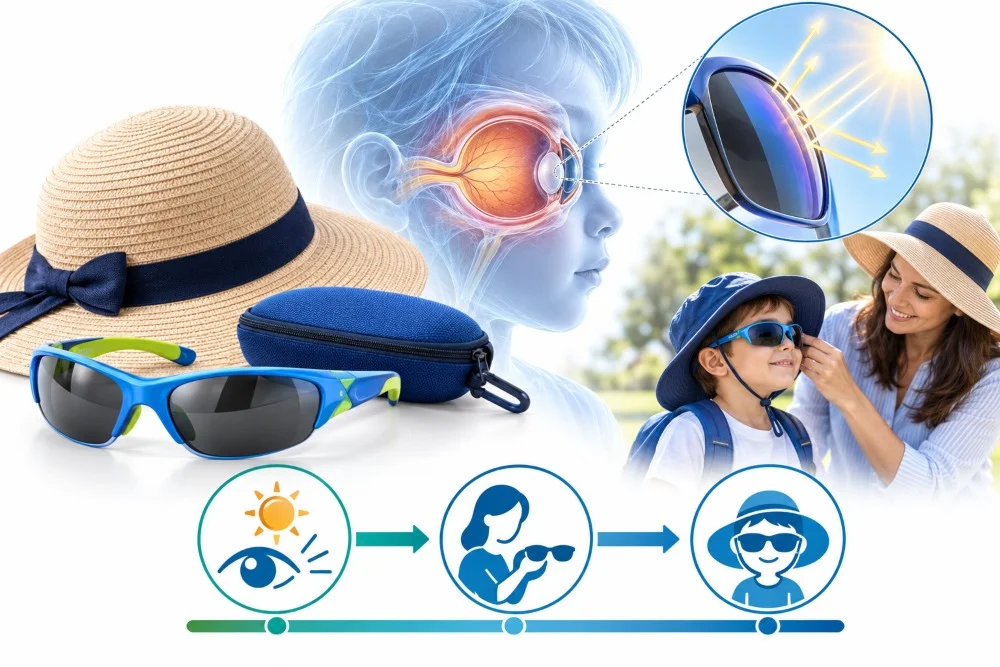
Most parents are broadly aware that sun protection matters. The gap is in execution, and a UK survey puts numbers on it that are worth seeing.
The College of Optometrists found that 55 percent of parents do not ensure their children wear sunglasses with UV protection outdoors. The detail underneath that figure is where it gets interesting.
- 42 percent of parents always wear sunglasses on sunny days, but only 30 percent say the same for their children. Adults protect themselves more reliably than they protect their kids.
- 38 percent believe a hat or cap means sunglasses are unnecessary.
- 32 percent say their child’s sunglasses are always lost or broken.
- 14 percent have struggled to find a pair that fits properly.
- 40 percent treat an eye test as a back-to-school priority, against 52 percent who prioritise uniform shopping.
Read as a set, these are not really a knowledge problem. Only one of them, the hat misconception, is about not knowing something. The rest are practical failures: the glasses get lost, they do not fit, nobody got round to it.
That matters because it changes what actually helps. Telling parents that UV exposure is harmful addresses the 38 percent who think a hat is sufficient, and does nothing for the 32 percent whose child’s sunglasses are at the bottom of a swimming bag. For those families the useful intervention is a cheap second pair, a strap, and keeping one in the car.
On the hat question specifically, the survey notes that a hat combined with sunglasses can cut ultraviolet reaching the eyes by up to 98 percent. A hat alone helps considerably, by shading from above where much of the direct exposure comes from, and it does not address light arriving from the sides or reflecting upward off ground, water or snow. The two work together rather than substituting for each other.
How to Get Both
The practical version, now that the apparent conflict is resolved.
Aim for roughly two hours outdoors a day, and do not let weather talk you out of it. This is the figure that comes out of the outdoor-time research, and the brightness that matters is still present under cloud. Outdoor light on an overcast day is far more intense than any indoor lighting. Break time, the walk to school, after-school play and weekends all count. It does not need to be sport.
Put sunglasses and a hat on them while they are out there. The daylight benefit survives sunglasses. The ultraviolet risk largely does not. There is no trade-off to manage.
Pay attention to the middle of the day. The NEI suggests limiting time outdoors when the sun is strongest, usually between 10am and 4pm, and checking the UV index, which can be high even when it is cloudy. For families who cannot avoid those hours, that is an argument for better protection rather than for staying in.
Treat reflective environments as a separate category. Snow, water, sand and pale concrete bounce ultraviolet upward, from an angle that hats do not cover. Beach days, pool days and anything in the snow need proper wraparound protection, not a baseball cap.
Start young. Protection habits formed at four are unremarkable by ten. A child who has worn sunglasses outdoors for as long as they can remember does not experience them as an imposition, which is a much easier position than introducing them at twelve.
Build in redundancy. Given that a third of parents report the sunglasses are always lost or broken, own more than one pair, keep one in the car and one in the school bag, and use a retaining strap for younger children. The best eyewear is the pair that is actually present.
One honest note on what this achieves. Managing UV exposure well reduces a lifetime risk substantially. It does not eliminate it, and plenty of other factors, including genetics, are outside your control. The purpose is to avoid spending risk unnecessarily, not to guarantee an outcome.
Buying Sunglasses That Actually Work
This is the part where money gets wasted, and the rules are short.
The label is the product. Look for 99 to 100 percent UVA and UVB protection, or UV400. The NEI is explicit that price does not guarantee ultraviolet protection, and in the UK the College of Optometrists points to the CE or UKCA mark as the indication that a pair meets the relevant standard. If there is no marking at all, assume nothing.
Dark is not protection, and dark without a filter is worse than nothing. A tinted lens with no ultraviolet filter causes the pupil to open wider in the reduced light, which admits more ultraviolet to the back of the eye than bare sunlight would. This is the single most important thing to understand about buying children’s sunglasses, and it is why unlabelled novelty pairs from a holiday gift shop are an actively bad purchase rather than a neutral one.
Toy sunglasses are toys. Anything sold in the toy aisle, or as part of a costume, should be assumed to have no rating.
Coverage matters as much as the lens. Larger lenses and close-fitting or wraparound frames block light arriving from the sides and from below. For a small face this is mostly a fit question.
Fit decides whether they get worn. Given that 14 percent of parents report struggling to find a well-fitting pair, this is worth some effort. The frame should sit on the bridge and cheeks without pressing, and the arms should not slide. A retaining strap helps for under-sixes.
Polarisation is comfort, not protection. Polarised lenses cut glare off water and snow, which is genuinely useful and makes children more willing to keep them on. It is a separate property from ultraviolet filtering, so check for both.
UV-blocking contact lenses are a supplement, not a substitute. For older children in lenses, the NEI still recommends sunglasses over them, since contacts do not cover the lids or the surrounding tissue.
One reassurance: a properly rated pair of children’s sunglasses is not expensive. This is a labelling question rather than a budget one.
If Your Child Is Already Short-Sighted

This is the limitation of the outdoor-time finding that gets lost in the coverage, and it changes what you should do.
Outdoor time appears to work mainly by delaying the onset of myopia. The evidence that it slows progression in a child who is already nearsighted is considerably weaker. The landmark trial in Guangzhou, where adding 40 minutes of outdoor activity to the school day cut the three-year incidence of new myopia from 39.5 percent to 30.4 percent, was measuring new cases appearing, not existing cases worsening.
So if your child already wears glasses for distance, getting them outside remains worthwhile for general health and probably for their eyes. It is not the main lever any more.
The conversation to have instead is about myopia control, which is a set of treatments specifically intended to slow progression:
- Spectacle lenses designed for myopia control, which look like ordinary glasses and work by changing how light focuses in the periphery of the retina
- Certain soft contact lenses with a similar design principle
- Low-dose atropine eye drops
- Orthokeratology, which uses rigid lenses worn overnight
These are real interventions with a growing evidence base, and they are not always offered unless a parent asks. If your child’s prescription has moved significantly in a year, or they became short-sighted young, raise it directly at the next appointment and ask whether they are a candidate.
Why this matters beyond needing stronger glasses: higher degrees of myopia carry raised lifetime risk of retinal detachment, myopic macular degeneration and glaucoma. Slowing progression in childhood is not about convenience. It is about where the prescription stops.
The Absolute Rules, and When to Get Help
A few things are not matters of judgement.
Never let a child look directly at the sun, and never let them view a solar eclipse through sunglasses, smoked glass, a camera or a phone. Eclipse viewing requires certified filters. The retinal burn this causes is painless as it happens, which is exactly why children do not stop, and it is permanent.
Treat snow as the highest-risk environment. Reflected ultraviolet off snow is intense enough to cause corneal sunburn within hours, and the symptoms arrive later that evening when everyone is back indoors and not connecting the two.
Water and sand are the next tier. A day at the beach or pool delivers direct and reflected exposure simultaneously.
Seek medical care the same day for:
- Severe eye pain with light sensitivity and watering, especially hours after time in snow, water or strong sun
- Sudden loss or blurring of vision
- A white, grey or cloudy appearance in the pupil, including one that only shows in flash photographs
- A new eye turn appearing suddenly
- Any chemical splash or penetrating injury
- A red, painful eye that does not settle
And a note on the limits of an article like this one. General guidance describes populations, not your child. A single study, including the one this article is built around, is never the basis for a decision on its own, and this one is observational rather than experimental. Recommendations on UV exposure and on myopia control differ between countries and are being actively revised as the evidence develops.
The thing that is not in dispute: children’s eyes should be examined on schedule, whether or not anything seems wrong, because the conditions that matter most produce no complaint a child would think to make. If your child has never had a proper eye examination, that is a more valuable appointment than any sunglasses purchase.
Frequently Asked Questions
Does This Study Mean Sunlight Is Good for My Child’s Eyes?
Daylight is associated with lower rates of nearsightedness, and ultraviolet is associated with damage to the front of the eye. Both are true. The study measured a marker of sun exposure as a stand-in for time outdoors, and the time outdoors is what appears to protect. Get your child outside, with their eyes protected.
So Do Sunglasses Cancel Out the Myopia Benefit?
No. Sunglasses reduce overall brightness somewhat while blocking nearly all ultraviolet, so the bright-light exposure linked to lower myopia risk still gets through. There is no need to choose.
Can CUVAF Testing Tell Me If My Child Will Become Short-Sighted?
No. The study itself reports a positive predictive value of about 11 percent and specificity of about 30 percent, which means finding this marker says very little about an individual child. It is a research tool for comparing groups, not a screening test.
Is a Hat Enough?
It helps considerably and is not sufficient on its own, because it does not stop light arriving from the sides or reflecting upward from ground, water or snow. A hat plus sunglasses is the combination, and together they can cut ultraviolet reaching the eyes by up to 98 percent.
Do Cloudy Days Count?
For both purposes, yes. Ultraviolet passes through cloud, so protection is still needed, and outdoor brightness under cloud still far exceeds indoor lighting, so the benefit is still there.
My Child Refuses to Wear Sunglasses. What Now?
Start with fit, since discomfort is the usual reason. Let them choose from properly rated options so it feels like theirs, use a strap for younger children, and lean on a wide-brimmed hat and shade in the meantime. Something imperfect that gets worn beats a perfect pair in a drawer.
Medical Disclaimer
This article is general information and education only. It is not medical advice and does not replace an in-person assessment by a qualified optometrist, ophthalmologist, paediatrician or other healthcare professional. It describes a single observational study, which cannot establish cause and effect, alongside broader guidance; findings from one study should never be the sole basis for a decision about a child’s care. Recommendations on UV exposure, sun protection standards and myopia control differ between countries and are being actively revised as evidence develops, so confirm current guidance locally. Discuss your child’s individual circumstances with a qualified clinician, and for any of the urgent symptoms described above, seek medical attention the same day rather than relying on information from a website.
References
Sources consulted, accurate as of October 2026.
- Frontiers in Medicine (February 2026). Conjunctival ultraviolet autofluorescence as an objective biomarker of outdoor exposure and childhood myopia: a study of 2,262 schoolchildren in Madrid. frontiersin.org/journals/medicine/articles/10.3389/fmed.2026.1708836/full
- National Eye Institute. Protecting your eyes from the sun’s UV light: conditions linked to exposure and recommended protection. nei.nih.gov/research-and-training/research-news/protecting-your-eyes-suns-uv-light
- College of Optometrists (June 2025). Over half of parents don’t fully protect children’s eyes in the sun. college-optometrists.org/news/2025/june/childrens-eyes-not-protected-in-the-sun
- Community Eye Health Journal. Preventing myopia in East Asia, including the Guangzhou outdoor activity trial. ncbi.nlm.nih.gov/pmc/articles/PMC6688404
- World Health Organization. The known health effects of ultraviolet radiation. who.int/news-room/questions-and-answers/item/radiation-the-known-health-effects-of-ultraviolet-radiation
- American Academy of Ophthalmology. Vision screening for infants and children, clinical statement. aao.org/education/clinical-statement/vision-screening-infants-children-2022
- Centers for Disease Control and Prevention. Vision Health Initiative, covering eye disease, eye injury and vision loss prevention. cdc.gov/vision-health/cdc-program/index.html