


Most families build the back to school list the same way every year. Shoes, bags, stationery, a water bottle, maybe a haircut. Eyes almost never make the list, Back to School Eye Exams for Children and that is the quiet problem. A child who cannot read the board clearly will not usually announce it. They will squint, copy from a neighbour, lose their place on the page, and decide somewhere along the way that they are simply not good at reading.
That is why back to school eye exams matter more than their short appointment time suggests. A child has no reference point for normal vision. Whatever they see is simply what seeing is. They cannot tell you that the words are doubling, or that the far wall is soft and blurry, because they have never seen it any other way.
This guide covers what the exam actually involves, when to book it, what the school screening does and does not catch, and the signs that should move an appointment to the front of the queue.
Why Vision Problems Hide So Well in a Classroom
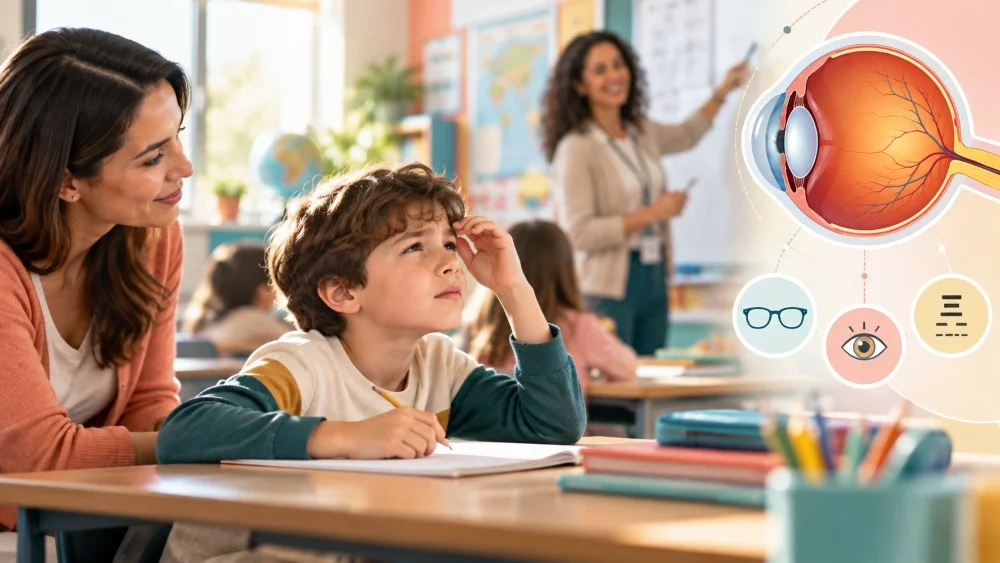
A child with blurry distance vision does not experience blur. They experience school. The board is just hard, the way some things are hard, and the brain gets very good at filling in gaps from context. This is why a teacher is often the first to raise it, and why a parent at home sees nothing unusual at all.
The behaviours that follow look like anything except an eye problem. A child who avoids reading. A child who finishes half the worksheet. A child who gets restless after twenty minutes of close work and is written up as unfocused. None of that points a parent towards an optometrist, which is exactly how uncorrected vision survives in a child for years.
The conditions behind it are more common than most parents expect. Population data from the National Eye Institute on preschool children found hyperopia in around 21 percent, astigmatism in around 10 percent, amblyopia in about 5 percent and strabismus in about 2 percent. Nearsightedness is lower at that age and then climbs steadily through the school years. These are not rare diagnoses. They are ordinary findings that simply need to be found.
One caution on the numbers that circulate every August. Claims such as “80 percent of learning is visual” or “one in four children has a vision problem” are repeated widely but trace back to weak or unclear sources. The honest version is better anyway. Vision problems in children are common, they are usually treatable, and treatment works best when it starts early.
A School Screening Is Not an Eye Exam

This is the single most useful thing in this guide, so it goes early. The vision check at school, or the chart your paediatrician uses at a well child visit, is a screening. It is a fast filter designed to catch obvious problems and flag children who need a closer look. It is genuinely useful. It is not a diagnosis.
A screening typically checks how well each eye reads a chart at distance, and sometimes alignment. A comprehensive exam checks the focusing system, how the two eyes work together, the prescription measured objectively rather than guessed, eye pressure where appropriate, and the health of the structures inside the eye. The American Academy of Ophthalmology sets out the difference between screening and a full exam and advises a comprehensive exam when a child fails a screening, when the screening cannot be completed, or when there is a vision complaint or a risk factor.
Three real limitations of screenings are worth knowing:
- Farsightedness slips through. A young child can force clear distance vision by focusing hard, pass the chart at 20/20, and still be exhausted by twenty minutes of reading.
- Near vision is often not tested. School charts are usually distance charts. Most of a child’s schoolwork happens at arm’s length or closer.
- Eye teaming is rarely checked. Convergence problems, where the eyes struggle to hold a single image up close, do not show up on a distance chart at all.
So a passed screening is reassuring, not conclusive. If your child is struggling and the screening was clear, that is a reason to book a full exam, not a reason to stop asking.
When to Book, and How Often
Two respected bodies give slightly different advice, and the gap confuses a lot of parents. Ophthalmology guidance leans on screening at well child visits with a full exam when something is flagged. Optometric guidance leans towards a full exam on a set schedule. Neither is wrong. They weigh access and cost differently.
| Age | Screening approach (AAO and AAP) | Comprehensive exam approach (AOA) |
|---|---|---|
| Birth to 12 months | Eye check in the newborn period and at well child visits | One full exam between 6 and 12 months |
| 3 to 5 years | Vision and alignment checks at ages 3, 4 and 5 | At least one full exam between ages 3 and 5 |
| Before first grade | Acuity and alignment screening | A full exam before starting first grade |
| 6 to 18 years | Screening every one to two years, with the AAP adding checks at 8, 10, 12 and 15 | A full exam every year |
The AOA moved to an annual recommendation for school-age children in its revised clinical guideline, on the reasoning that screenings alone miss too much. If your budget allows only one route, the practical middle ground most eye doctors would accept is a full exam before school starts, then yearly if your child wears correction or has symptoms, and every one to two years if everything was clear and nothing has changed.
On timing, book four to six weeks before term begins rather than the week before. If glasses are needed, lenses take time to make, frames sometimes need adjusting, and a child adapting to a first prescription is better doing it during holidays than during the first week of a new class. Late August and early September are also the busiest weeks of the year for back to school eye exams, so appointments go quickly.
One exception overrides all of this. If your child has a new symptom, do not wait for a scheduled slot.
What Actually Happens During the Appointment
Most parents picture the letter chart and nothing else. A full exam runs around 30 to 60 minutes and covers considerably more than that.
- History. Birth history, family history of glasses, squint, lazy eye or childhood eye disease, plus what you have noticed at home. Mention the small things. Head tilting and one closed eye during reading are clinically useful details.
- Visual acuity, adapted to age. A child who cannot read letters is tested with pictures, LEA symbols or a tumbling E chart. A preverbal child can still be assessed through fixation behaviour and preferential looking. There is no age too young to be examined.
- Eye alignment and movement. The cover test and tracking tasks reveal a turn or drift that nobody at home has seen.
- Depth perception and colour vision. Both are quick. Colour deficiency matters at school because so much early teaching material is colour coded.
- The prescription, measured objectively. Retinoscopy and autorefraction establish the refractive error without relying on a child answering which lens looks better. This is the part a screening cannot replicate.
- Eye health. The examiner inspects the front of the eye and the retina for anything structural.
Dilating drops are common in children, and this is where most appointment anxiety lives. The drops relax the focusing muscle so the true prescription cannot be masked by a child’s powerful ability to focus. This matters most with farsightedness, which hides easily. Expect the drops to sting for a few seconds, then blurry near vision and light sensitivity for roughly four to six hours. Bring sunglasses. Do not plan homework or a reading-heavy afternoon straight afterwards.
What you say beforehand changes how the visit goes. Avoid the words test and pass, because a child who thinks they can fail will guess rather than admit uncertainty. Describe it as the doctor looking at how their eyes work, with lights, pictures and some funny glasses. Guessing to please the examiner is the single most common way a child’s exam gets skewed.
Signs That Should Move the Appointment Forward
Children report symptoms badly, so watch behaviour instead of waiting for a complaint. Any of the following is worth an appointment sooner rather than later.
- Sitting very close to the screen, or holding books unusually close
- Squinting, or tilting the head consistently to one side to look at something
- Covering or closing one eye to read or watch
- Frequent eye rubbing when not tired, and frequent blinking
- Headaches, especially late afternoon or after homework
- Losing their place while reading, skipping lines, or using a finger well past the age you would expect
- Short attention span specifically for near work, while concentration on other activities is fine
- Clumsiness, or difficulty judging distance when catching a ball or pouring a drink
- An eye that drifts, even occasionally, after infancy
- Avoiding reading and homework with unusual intensity
That last one deserves emphasis. Resistance to reading is read as laziness far too often. A child whose eyes cannot comfortably hold focus at 30 centimetres is not being difficult. They are avoiding something that genuinely hurts.
If any of these are present, do not wait for the usual back to school eye exams window in late summer. Book now, and say on the phone what you have noticed, because it changes which tests the examiner prioritises.
What the Exam Commonly Finds
| Finding | What it means in plain terms | Usual approach |
|---|---|---|
| Myopia (nearsighted) | Distance is blurry, close work is clear. Usually appears and progresses during school years | Glasses, with myopia control options discussed if it is progressing quickly |
| Hyperopia (farsighted) | The eye must work harder to focus, especially up close. Often missed by chart screening | Glasses when the degree is significant or symptoms are present |
| Astigmatism | The eye surface is shaped more like a rugby ball than a football, so vision is blurred at all distances | Glasses |
| Amblyopia (lazy eye) | One eye has weaker vision because the brain learned to favour the other during early development | Glasses first, then patching or atropine drops to make the stronger eye work less |
| Strabismus (squint or eye turn) | The eyes do not point in the same direction | Glasses, patching, exercises, sometimes surgery |
| Convergence insufficiency | The eyes struggle to turn inwards and hold a single image up close | Supervised eye exercises, sometimes reading glasses with prism |
| Colour vision deficiency | Certain colours are hard to tell apart, most often reds and greens | No treatment, but the school should know, since colour-coded materials are everywhere |
Amblyopia is the one worth understanding properly, because timing genuinely matters. The visual system is still wiring itself through early childhood, and treatment generally works better the earlier it starts. Older children can still improve, so a late diagnosis is never a reason to give up, but a diagnosis at four is a far easier problem than the same one at ten.
A note on vision therapy. Supervised treatment for convergence insufficiency has reasonable evidence behind it. Broader claims that eye exercises treat dyslexia or learning disabilities do not, and major paediatric eye and paediatric bodies have pushed back on them. If a clinic proposes a long and expensive therapy package for a reading problem, a second opinion is sensible.
Myopia, Screens, and What the Evidence Actually Supports

Nearsightedness in children is rising across much of the world, and parents usually blame screens. The research tells a more specific story, and the distinction is practical rather than academic.
The strongest finding is about daylight, not devices. In a three-year randomised trial in Guangzhou, adding 40 minutes of outdoor activity to the school day cut the cumulative incidence of new myopia from 39.5 percent to 30.4 percent. Later trials point the same way, with a dose response: more outdoor time, lower risk of onset. The common target is around two hours outdoors daily. Outdoor light is many times brighter than indoor light even on a cloudy day, and that brightness appears to be the active ingredient.
Importantly, outdoor time mainly delays myopia starting. It does far less for a child who is already nearsighted. For those children, the conversation shifts to myopia control, which includes specially designed spectacle lenses, certain contact lenses and low dose atropine drops. Ask your eye doctor directly whether your child is a candidate, because these options are not always offered unless a parent raises them.
What about screens themselves? The evidence that screen time independently drives myopia is weaker than the headlines suggest, partly because screen time and indoor time are tangled together. Heavy close work does seem to matter. The practical advice survives either way: get the child outside, and break up long stretches of near work.
The 20-20-20 habit is the usual suggestion here. Every 20 minutes, look at something around 20 feet away for about 20 seconds. Be honest with yourself about its status. It is sensible, low cost and widely recommended for comfort, but it is a rule of thumb rather than a proven preventive measure. Treat it as a comfort habit, and treat outdoor time as the intervention with real evidence behind it.
If Glasses Are Prescribed
A prescription is not automatic. Mild farsightedness is normal in young children and often needs nothing. When glasses are prescribed, ask one question before you leave: are these for full time wear, or only for reading and board work? Parents frequently get this wrong, and with amblyopia or an eye turn, inconsistent wear can undo the treatment.
Getting a child to keep glasses on is mostly a fit problem dressed up as a behaviour problem. A few things genuinely help.
- Let the child choose the frames. Ownership does more for compliance than any amount of persuasion.
- Insist on a proper fit at the bridge and temples. Glasses that slide down get pushed up all day and then abandoned.
- Ask about polycarbonate lenses. They are lighter and far more impact resistant, which matters for a child who plays.
- Expect a short adjustment period. A first prescription can make the floor feel tilted for a few days. If that lasts beyond a week, go back.
- Keep a spare pair if you can afford one, and tell the teacher the glasses exist so they can prompt without making it a confrontation.
If your child says the glasses make things worse, take it seriously and return for a recheck. Children rarely invent that complaint, and a prescription written while a child was tired or guessing can be wrong. This is also why many clinicians prefer a follow-up a few weeks after the first pair, rather than waiting a full year for the next round of back to school eye exams.
Cost, Coverage, and What to Do Without It
Cost is the reason a lot of these appointments never get booked, so it is worth knowing what is already covered.
In the United Kingdom, children under 16 get a free NHS sight test and an optical voucher towards glasses, and that voucher also covers repairs or replacements. Young people under 19 in full time education qualify too. Many parents pay privately without realising the test was free.
In the United States, children’s vision care is an essential health benefit on most marketplace plans, and Medicaid and CHIP generally cover eye exams and glasses for children. If you have no coverage at all, Prevent Blindness maintains a directory of vision care financial assistance programmes covering exams and glasses. Several national programmes provide free glasses to children in low income families, and some optometrists offer a free assessment for infants between 6 and 12 months.
Three further routes worth trying if money is tight. Ask the school nurse, since many districts run vision programmes or have links to charities that supply glasses. Ask the optometrist directly about payment plans, because many will quietly arrange one. Check whether an optometry teaching clinic operates near you, as these usually charge much less and are supervised by faculty.
To keep the spending sensible, remember that the exam and the glasses are separate purchases. You are entitled to your child’s prescription, and you can take it elsewhere. For a growing child who sits on their glasses, a modest frame replaced when needed often beats an expensive one protected anxiously.
What to Ask, and What to Do Afterwards
Appointments move fast and parents think of the good questions in the car park. Take this list in with you.
- Was the prescription measured with dilating drops, and if not, should it be?
- Is this a full time prescription, or for near work only?
- How do the two eyes compare, and is there any sign of amblyopia or an eye turn?
- Is the nearsightedness progressing, and would myopia control be appropriate?
- Where should my child sit in class?
- When do you want to see them again, and what would make you want to see them sooner?
- Can I have a written copy of the prescription and the findings?
That last one matters more than it sounds. A short written summary lets you tell the school something specific instead of something vague.
Following up with the school is the step most parents skip, and it is where back to school eye exams actually translate into classroom benefit. Tell the class teacher what was found, whether glasses are needed and when, and whether seating should change. Ask them to let you know if the glasses are not being worn, without turning it into a discipline issue. If your child has a colour vision deficiency, say so explicitly, because colour-coded reading groups and worksheets are common and easily adapted once someone knows.
Finally, put the next appointment in the calendar before you forget. Eyes change quickly in childhood, and a prescription that was right in September can be wrong by spring.
Urgent Signs, and the Limits of a Routine Exam
Some symptoms are not a scheduling question. Seek urgent medical care, the same day, for any of these.
- Sudden loss or blurring of vision, in one eye or both
- A white, grey or cloudy reflection in the pupil, including one that only shows up in flash photographs
- Any eye injury, especially a chemical splash, a blow to the eye or something that may have penetrated it
- Severe eye pain, or a red painful eye with strong light sensitivity
- A new eye turn that appears suddenly, particularly alongside double vision, headache or vomiting
- A rapidly swollen eyelid with fever, or an eye that looks pushed forward
A white pupil reflex in particular should never be watched and waited on. It is usually something benign, but it is also how a small number of serious conditions first show themselves, and it needs same-day assessment.
It is equally worth being clear about what a routine exam cannot do. It is not a learning assessment. A child can have perfect eyes and still have dyslexia, ADHD or a language difficulty, and a clear eye exam result should move the investigation elsewhere rather than end it. Coloured overlays and tinted lenses for reading remain popular and poorly supported by evidence. Online vision tests and phone apps are not an alternative to an in-person exam, since they measure almost nothing about eye health or focusing, and a reassuring result from one can delay a real diagnosis.
Routine care also leaves out eye safety, which no exam covers. Protective eyewear for school sports and for science or workshop classes prevents injuries that no amount of back to school eye exams can undo afterwards, and eye injury prevention sits alongside eye disease in the public health work the CDC groups under vision health. If your child plays a ball sport or racquet sport, ask the optometrist about impact resistant sports eyewear.
Frequently Asked Questions
At What Age Should Back to School Eye Exams Start?
A first full exam is commonly recommended between 6 and 12 months, another between ages 3 and 5, and one before first grade. After that, yearly if your child wears correction or has symptoms, and every one to two years otherwise. A child does not need to read, or even speak, to be examined.
My Child Passed the School Screening. Do They Still Need an Exam?
A pass is reassuring but not conclusive, because screenings mainly test distance vision and miss farsightedness, focusing problems and eye teaming issues. If your child has symptoms or is struggling with reading, book the full exam regardless of the screening result.
How Long Does the Appointment Take, and Will the Eyes Be Dilated?
Allow 30 to 60 minutes, and longer if drops are used, since they need around 20 to 30 minutes to work. Dilation is common for children and makes the prescription far more reliable. Expect blurry near vision and light sensitivity for several hours afterwards.
Does Screen Time Damage My Child’s Eyes?
Screens cause tired, dry and uncomfortable eyes, which is real but temporary. The evidence that screens independently cause nearsightedness is weaker than the headlines imply. The stronger and more useful finding is that time outdoors helps delay myopia from starting.
My Child Says They Can See Fine. Should I Still Book?
Yes. Children compare their vision to nothing, so a child with a lifelong blur has no idea anything is wrong. This is precisely why back to school eye exams are scheduled on age rather than on complaints.
Medical Disclaimer
This article is for general information and education only. It is not medical advice, and it is not a substitute for an in-person assessment by a qualified optometrist, ophthalmologist, paediatrician or other healthcare professional. Guidance on back to school eye exams varies between countries and professional bodies, and recommendations may change. Always discuss your child’s individual circumstances with a qualified clinician, and seek urgent medical attention for the symptoms listed above rather than relying on information from any website.
References
Sources consulted, accurate as of October 2026.
- American Academy of Ophthalmology. Vision screening for children: recommended schedule and how screening differs from a comprehensive exam. aao.org/eye-health/diseases/children-eye-screening
- American Optometric Association. Revised evidence-based clinical practice guideline on comprehensive paediatric eye and vision examination. aoa.org/about-the-aoa/press-room/press-releases/annual-eye-exams-for-children
- National Eye Institute. Data from the largest paediatric eye study on the prevalence of refractive error, amblyopia and strabismus. nei.nih.gov/about/news-and-events/news/national-institutes-health-releases-data-largest-pediatric-eye-study
- Community Eye Health Journal. Preventing myopia in East Asia, including the Guangzhou outdoor activity trial. ncbi.nlm.nih.gov/pmc/articles/PMC6688404
- NHS. Free NHS eye tests and optical vouchers. nhs.uk/nhs-services/opticians/free-nhs-eye-tests-and-optical-vouchers
- Prevent Blindness. Vision care financial assistance information directory. preventblindness.org/vision-care-financial-assistance-information
- Centers for Disease Control and Prevention. Vision Health Initiative, covering eye disease, eye injury and vision loss prevention. cdc.gov/vision-health/cdc-program/index.html